Short Project Summary
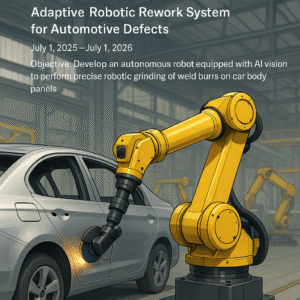
ARRAS—Adaptive Robotic Rework System for Automotive Defects—is an intelligent robotic solution developed to detect weld burrs and weld-spatter defects on automotive body surfaces and selectively sand only the areas that require treatment.
The completed prototype combines machine vision, artificial intelligence, a protected movable camera, load-cell-based force control, custom embedded electronics, ROS2 software and an aluminium robotic end effector. The complete system was successfully integrated with a Doosan H2515 industrial robot and demonstrated on both a flat sheet-metal specimen and an actual vehicle body surface.
The Industrial Challenge
During automotive body-in-white production, welding operations may leave burrs, raised particles and weld-spatter defects on the vehicle surface. These defects must be removed before the vehicle proceeds to sealing and painting.
Conventional robotic systems generally follow predefined grinding paths and may sand an entire surface region even when only a small part of that region contains a defect. This “blind grinding” approach leads to unnecessary abrasive consumption, additional robot movement, increased mechanical wear and avoidable removal of the protective surface layer.
Following technical discussions with Altınay Robot Technologies and observations of the automotive rework process at TOFAŞ, the ARRAS concept was refined into a “see-before-grind” approach: the robot first inspects the surface, identifies the areas requiring intervention and then sands only the detected defect locations.
The ARRAS Solution
The ARRAS system is based on a camera-integrated robotic end effector developed specifically for selective automotive surface rework.
Before sanding, the robot positions the end effector at the inspection point. The camera moves out of its protective housing, captures an image of the surface and transfers the image to the AI perception module. The software identifies burr-prone regions and converts their pixel positions into physical robot motion targets.
After image acquisition, the camera retracts into its protective enclosure to prevent damage from metal particles and sanding dust. The robot then approaches the selected area and performs the sanding operation only on the detected defect region.
Four load cells integrated into the end effector continuously measure the contact force between the sanding tool and the workpiece. The robot uses this feedback to regulate the applied force throughout the sanding motion.
Integrated Hardware and Software
The final ARRAS prototype brings several engineering components together in a single operational system:
- a CNC-manufactured aluminium end-effector structure;
- a protected and servo-actuated movable camera mechanism;
- an orbital sanding module;
- four load cells for contact-force measurement;
- a custom STM32-based embedded control board;
- CAN Bus communication between the end effector and the control computer;
- a ROS2 Humble-based modular software architecture;
- a graphical operator interface for camera, AI, robot and force monitoring;
- AI-based weld-burr instance segmentation; and
- communication and motion-control integration with the Doosan H2515 robot.
The operator interface displays the live camera image, AI detections, load-cell measurements and robot status. It also manages the complete autonomous task sequence, including inspection, target generation, robot positioning, force-controlled contact, sanding and return to the safe position.
AI and Dataset Development
Developing a reliable perception system for reflective automotive metal surfaces was one of the most demanding parts of ARRAS. Small weld-spatter defects can resemble holes, fasteners, shadows, surface reflections and pressed body geometries.
The project therefore combined controlled laboratory data generation with real automotive production images. Initial experiments were conducted on DKP sheet-metal plates, where representative welding defects were produced under controlled conditions. Different illumination angles, polarization methods and cameras were evaluated to reduce specular reflections.
A second and more extensive dataset was collected from actual automotive body surfaces at TOFAŞ. In total, 1,595 real factory images were annotated. Because the defects were small and irregular, polygon-based instance-segmentation labels were used instead of simple rectangular bounding boxes.
The AI development process included 139 training configurations, covering different model sizes, image resolutions, augmentation methods, dataset combinations, annotation approaches and training parameters. A quality-controlled subset of 1,244 images was selected for final model development. The final perception configuration used a high-resolution YOLO11M-seg model to preserve the visual characteristics of very small weld-spatter defects.
Final Industrial Demonstration
The final ARRAS demonstration was conducted on 27–28 July 2026 at the facilities of Altınay Robot Technologies.
The completed aluminium end effector was mounted on a Doosan H2515 industrial robot. Ethernet communication was established between the robot controller and the Ubuntu-based control computer, allowing the ARRAS software to read robot status information and transmit motion commands.
The validation was completed in two stages.
First, the system inspected a flat sheet-metal specimen, detected the burr-like target area and guided the robot to the identified location. The robot then performed the sanding operation while regulating the contact force.
In the second stage, the system was demonstrated on an actual vehicle body surface containing representative burr-like defects. The AI module identified the relevant regions, transformed the image coordinates into robot motion targets and directed the robot to each selected location.
During sanding, the system maintained an approximately 25 N contact force with an error below ±5%. Following the operation, the targeted burr-like structures were fully removed from the treated regions.
The final demonstration confirmed the complete ARRAS workflow:
surface inspection → AI-based defect localisation → robot target generation → force-controlled approach → selective sanding → safe withdrawal
Main Project Achievements
ARRAS successfully delivered:
- an operational camera-integrated robotic sanding end effector;
- a protected camera mechanism suitable for dusty rework environments;
- an AI dataset based on both controlled experiments and real automotive surfaces;
- a high-resolution instance-segmentation pipeline for weld-burr localisation;
- a custom STM32 and CAN Bus-based control architecture;
- load-cell-based force monitoring and regulation;
- ROS2 integration with a Doosan H2515 industrial robot;
- selective sanding on sheet metal and a real vehicle body surface; and
- a complete end-to-end industrial proof of concept.
Industrial Value and Future Development
ARRAS demonstrates how machine vision and force-aware robotics can replace area-based grinding with a more selective and intelligent rework strategy.
By sanding only the regions where defects are detected, the proposed approach has the potential to reduce unnecessary robot movement, abrasive consumption, equipment wear and surface-layer removal. It can also reduce workers’ exposure to repetitive, noisy and particle-generating manual sanding activities.
The completed prototype provides a strong foundation for the next industrialisation phase. Future development will focus on expanding the automotive dataset, accelerating AI inference through industrial GPU hardware, integrating a production-grade sanding unit, reducing the total cycle time and conducting longer-term validation under real production-line conditions.
Project Video
The following video presents the ARRAS development process, the completed end effector and the final vision-guided, force-controlled robotic sanding demonstration.

0 yorum